Before the towers
Two buildings, a dozen lives.
Long before three 600-foot towers were drawn, this Downtown Bellevue block held a single-screen movie palace and the bowling alley next door. Each outlived its original purpose by decades, passing through electronics showrooms, furniture floors and church congregations before the wrecking crews arrived in 2026.
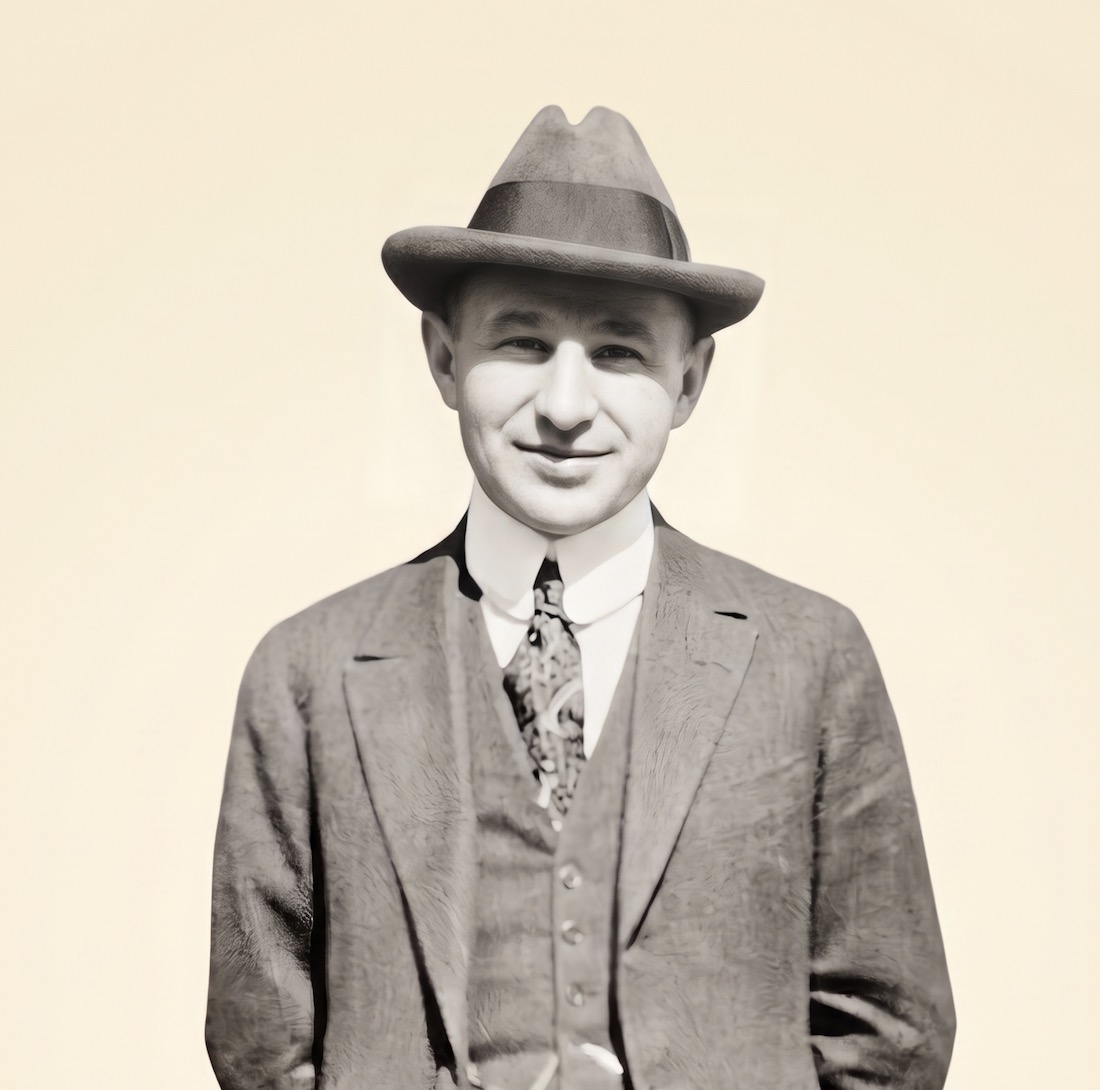
The name on the marquee
From a Seattle clothing shop to 116 screens.
Born Israel Danowsky in Bronsk, Russia in 1877, John Danz fled the pogroms with his family at age four, reaching the United States in 1882. He arrived in Seattle in 1903 and opened a men's clothing store.
In 1913 he began running a nickelodeon next door — at first just to draw shoppers — and discovered his real calling. That single storefront grew into Sterling Theatres, later the Sterling Recreation Organization (SRO), the largest independent theatre circuit in the Pacific Northwest.
Danz ran the empire from the Palomar Theatre Building in downtown Seattle from 1936, keeping it alive through the Depression and the rise of television by pioneering deluxe suburban movie houses like the Admiral, the Magnolia and the Northgate. He died in 1961 — the same year the Bellevue theatre bearing his name opened its doors.
His son Fredric carried SRO to its peak: roughly 110 theatres and 116 screens by the mid-1980s, the largest movie-theatre company in Washington, before selling the cinema operations to Cineplex Odeon in 1986. The family's Sterling Realty Organization held onto the Bellevue land for another three decades.
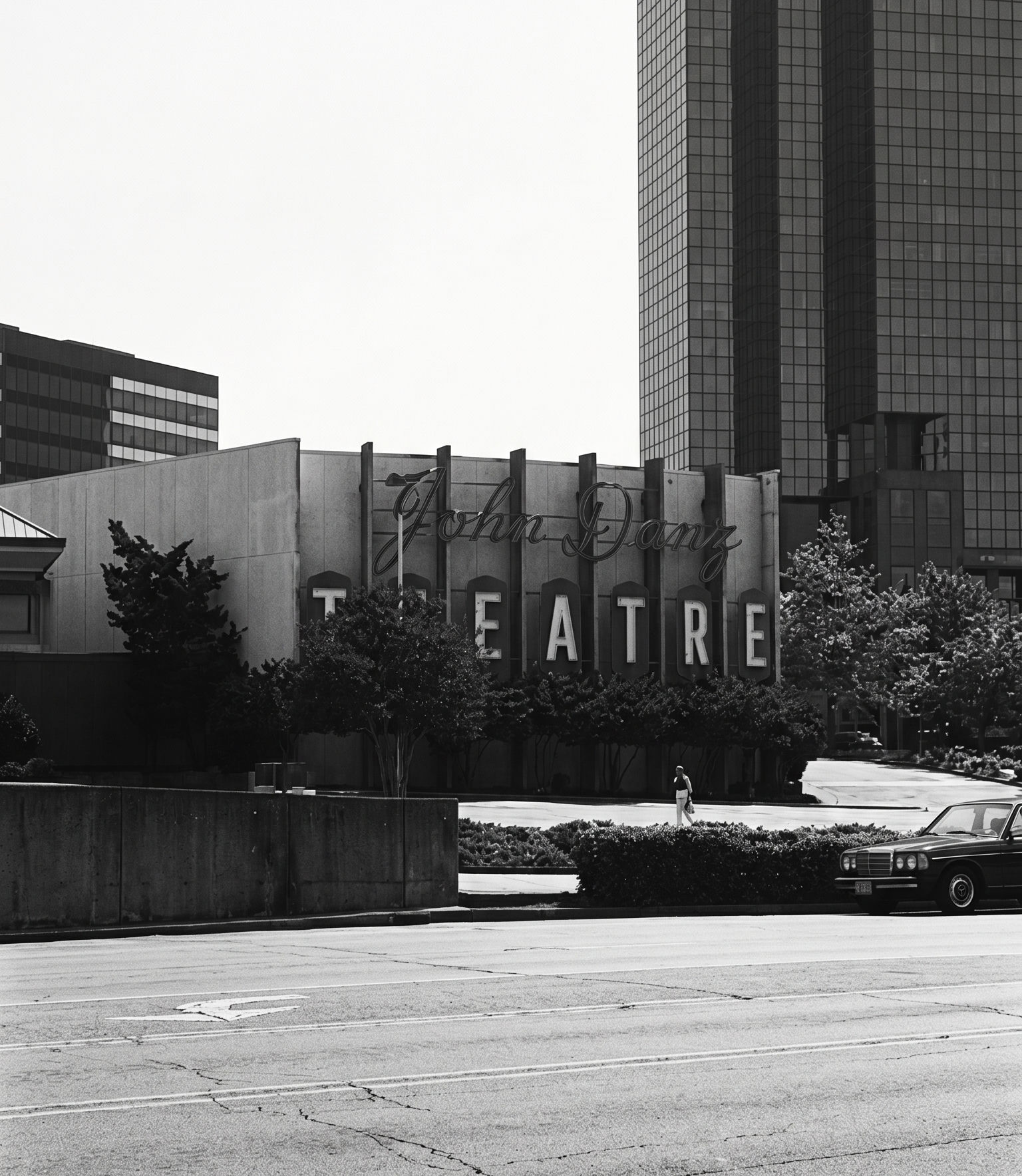
Building One
John Danz Theatre
601 106th Ave NE · 1961 – 2026
A 1,500-seat, single-screen movie house — built into the slope of the block, with SRO's corporate offices tucked on the floor above the auditorium and a tall rear sign carried on six vertical supports.
| Opened | Dec 22, 1961 |
|---|---|
| Screens | 1 (single auditorium) |
| Seats | ≈1,500 |
| Format | 70mm — an SRO "Big 4" house |
| Built | 1960–61, into the slope |
| Operator | Sterling (SRO) |
| Closed as cinema | c. 1990 |
- 1961–1990
The movie house
Opened the year John Danz died, the single-screen house was one of Sterling's vaunted 'Big 4' Northwest theatres — alongside Seattle's Northgate and Cinerama and Tukwila's Southcenter — the rooms that almost always landed the 70mm blockbusters of the 1970s and '80s. Built into the slope, its projection booth was reached by a door at the rear, next to a parking stall reserved for the union (IATSE) projectionist. SRO kept its head office on the floor above the auditorium. One account puts the very last picture on August 4, 1994.
- 1990
Saved from the wrecking ball — once
Slated for demolition to become a parking lot for Wright-Runstad's proposed First Interstate Bank tower, the building drew a counter-proposal: city manager Phil Kushlan and councilwoman Margot Blacker floated converting the 1,500-seat hall into a ~$15M performing-arts center. It never penciled out — the room had no stage, fly loft, backstage or real acoustics — and SRO objected, but the teardown stalled and the building survived as retail.
- c. 1991–2005
The Good Guys! years
The former auditorium reopened as a Good Guys! electronics and appliance showroom, which traded until late 2005.
- c. 2006–2015
Underhills Furniture
Furniture filled the lower floors next, while the Danz family kept corporate headquarters on the second floor — a quiet continuity from the cinema days.
- c. 2015–2022
Doxa Church
The old auditorium found new life as a sanctuary, home to Doxa Church for about seven years until the congregation relocated to Redmond in 2022.
- 2022–2026
One last congregation
Another church occupied the former theatre right up until demolition — the building's final tenant after 65 years of near-continuous use.
Building Two
Belle Lanes → Barnes & Noble
626 106th Ave NE · 1957 – 2026
The bowling alley came first — Belle Lanes, a downtown Bellevue fixture for 35 years — before being remodeled into one of the Eastside's best-known bookstores, and finally a furniture showroom.
| Belle Lanes opened | 1957 |
|---|---|
| Lanes | 32 |
| Belle Lanes closed | 1992 |
| Became Barnes & Noble | 1993 |
| B&N tenure | ≈29 years |
| B&N relocated | Fall 2022 → Crossroads |
| Final use | Furniture store |
- 1957–1992
Belle Lanes
Opened in 1957 when Bellevue was barely a town, Belle Lanes was a 'curved, squat, beige bunker' of 32 lanes under subdued light, with 20-foot letters spelling B-O-W-L across the roofline. The Danz family's SRO owned it too — close enough to the cinema that moviegoers slipped over between showings to bowl a frame or play the arcade. A $300,000 refit late in life added automatic scoring, resurfaced lanes and automatic ball returns; the luncheonette poured beer on tap and built its reputation on a roasted-turkey sandwich (with fries, $3.95) so good that SRO president Fred Danz swore off the burgers for it. Leagues like the Blazing Hopefuls — among them 76-year-old Lillian Larson — kept it rolling on some of the priciest land in the city, wedged between the banks and Bellevue Square, for 35 years.
- 1993–2022
Barnes & Noble
A few months after the lanes closed, the building was remodeled into a Barnes & Noble. For 29 years the 626 106th Ave NE store was a Downtown Bellevue institution — until, anticipating the redevelopment, it announced its move and decamped to Crossroads Mall in fall 2022, the new store opening the day after the old one shut.
- 2022–2026
Furniture, to the end
The cavernous former bookstore spent its final years as a furniture showroom, trading right up until the block was cleared.
One block, end to end
A chronology of the site.
- 1957
Belle Lanes opens
A bowling alley arrives on 106th Ave NE.
- 1961
John Danz Theatre opens
A 1,500-seat single-screen cinema opens Dec 22, the year its namesake dies.
- 1990–94
Theatre dims; demolition averted
Slated for a parking lot, the cinema is spared after an arts-center proposal stalls the teardown. Accounts differ on the last screening (1990 vs. Aug 1994).
- 1992–93
Lanes → bookstore
Belle Lanes closes; the building is remodeled into Barnes & Noble.
- 1991–2005
Good Guys! in the theatre
The former auditorium becomes an electronics showroom.
- 2006–2015
Underhills Furniture
Furniture fills the old theatre's lower floors.
- 2015–2022
Doxa Church
The auditorium becomes a sanctuary for about seven years.
- 2019
Onni buys the block
Onni Group acquires the ~4 acres from Sterling Realty Organization for $116M.
- 2022
B&N leaves; Doxa leaves
Barnes & Noble moves to Crossroads; Doxa relocates to Redmond. A furniture store and another church move in.
- 2026In progress
Demolition
After decades of reinvention, both buildings finally come down.
Footnotes
Things people remember.
- 01
The John Danz was one of Sterling's 'Big 4' — with Seattle's Northgate and Cinerama and Tukwila's Southcenter — the houses that landed the era's 70mm blockbusters.
- 02
A laser show reportedly preceded the opening-day screening of Star Trek II at the theatre.
- 03
One former ticket-taker recalled possibly tearing a ticket for a young Bill Gates around 1961–62.
- 04
A parking stall at the back of the theatre was reserved for the union (IATSE) projectionist, beside the rear door into the booth.
- 05
Belle Lanes wore its name in 20-foot letters — B-O-W-L — atop a beige 1950s bunker of 32 lanes.
- 06
The bowling alley's roasted-turkey sandwich ($3.95 with fries) won over even SRO president Fred Danz, who gave up the burgers for it.
- 07
US West managers bowled summer rates of $1.49 for three games; the Blazing Hopefuls women's league counted 76-year-old Lillian Larson among its keenest.
- 08
By its church years the old auditorium had been stripped of cinema fittings down to bare black walls — the Danz offices long gone from the floor above.
Sources & further reading
- Cinema Treasures — John Danz Theatre ↗
- PCAD — Danz, John, Theatre, Bellevue ↗
- Seattle Times (1990) — Parking lot or arts center? ↗
- Seattle Times (1990) — Belle Lanes is still on a roll ↗
- CinemaTour — John Danz Theatre, Bellevue ↗
- Downtown Bellevue Network — Barnes & Noble to move to Crossroads ↗
- HistoryLink — Fredric A. Danz ↗
Some early dates are approximate and drawn from archival listings and reader recollections; corrections are welcome.